

Citizenship by Investment
Turkish Citizenship by Investment
With Turkey citizenship by investment, Türkiye can grant citizenship to a foreign investor who makes a qualifying investment. For most people that means property worth at least USD 400,000, kept for three years; a spouse and minor or dependent children can join the same application. There are six other routes too, from a bank deposit to employing 50 people.
This page is the overview: who can apply, how the routes compare, how long it takes, what it costs and what you actually get at the end. Where a topic needs more depth, we link to the guide that covers it properly.
See investment routes
At a glance
At a Glance: Turkish Citizenship by Investment
Turkish citizenship by investment is a legal route to Turkish nationality for foreign investors who make a qualifying investment — most commonly real estate — and meet the requirements set by Turkish law
- Minimum investment
- USD 400,000 in property, or USD 500,000 for the deposit, bond, fund, pension and fixed-capital routes — or 50 jobs
- Timeline
- Usually six months to a year from investment to passport; not guaranteed — see timeline
- Family
- Your spouse and minor or dependent children apply with you
- Holding period
- Three years for the property, deposit, bond, fund and pension routes
- Residence
- You don’t have to live in Türkiye, before or after
- Status
- Doesn’t lapse when you sell the investment after the holding period; held subject to Turkish Citizenship Law
- Dual citizenship
- Türkiye allows it — check your own country’s rules
Turkish citizenship, once granted, is held indefinitely subject to Turkish Citizenship Law
Figures and timelines shown are indicative, depend on the Turkish authorities, and require verification — confirm binding details with an advisor.
The program
What Is Turkish Citizenship by Investment?
It’s a form of “exceptional” citizenship under article 12 of Turkish Citizenship Law No. 5901 (Turkish text). Normal naturalisation takes years of residence, a language test and an income check. This route skips all that, because the investment itself is the basis on which the state can grant citizenship.
It isn’t automatic, though. The decision is discretionary, it’s made by Presidential decision, and every applicant goes through a security review. Several authorities have a hand in it: the land registry or the relevant ministry confirms the investment, the Presidency of Migration Management issues the residence permit, and the civil registry (Population and Citizenship Affairs, NVİ) prepares the citizenship file on the Ministry of Interior’s instruction.
Official bodies referenced in this program
The route is designed for non-Turkish investors who want a second citizenship — often for global mobility, family planning, or diversifying where they hold assets. It tends to suit internationally minded families and entrepreneurs who prefer to pair an investment in Turkey with a long-term connection to the country.
This is the investment route to Turkish citizenship. Acquiring nationality by descent or by marriage follows different rules (see our FAQs) — and no route means simply “buying a passport”: every application is subject to eligibility and security review.
Prefer to see the sequence involved? See how the process works step by step.
Turkish citizenship legislation can change; the legal details in this guide are indicative and should be confirmed with an advisor.
| Attribute | Plain-language description |
|---|---|
| Program type | Exceptional citizenship — not residence-based |
| Legal basis | Turkish Citizenship Law No. 5901, Article 12 |
| Deciding authority | Granted by Presidential decree |
| Administering bodies | Land registry or the ministry or regulator for your route (investment); Presidency of Migration Management (residence permit); civil registry — NVİ (citizenship file) |
| Qualifying basis | One of seven investment routes (see Investment Routes) |
| Who it’s for | Non-Turkish investors seeking a second citizenship |
Eligibility
Who Is Eligible?
Any foreign adult with no legal bar against them can apply, once they’ve made a qualifying investment through one of the investment routes. A few nationalities face extra restrictions, mainly on buying property in certain areas, so check this before you choose a route. Expect to visit Türkiye at least once for fingerprints and photos.
Eligibility is not approval. Meeting these conditions lets you apply — the final decision rests with the Turkish authorities.
Foreign buyers can generally acquire property in Turkey within the limits of the Land Registry Law No. 2644 (art. 35, Turkish text): nationality-based eligibility, area caps and military or security zones. To count toward citizenship, the property must also be eligible under the qualifying route.
Fingerprints and photos for the residence permit and the citizenship file are taken in person. Most other steps can be done by power of attorney; an advisor confirms which ones in your case.
Adult children are the question we’re asked most. If your son or daughter is 18 or over and independent, they aren’t covered, even if they live with you. More detail, including children from a previous marriage, is in our requirements guide.
| Who | Included? | Key condition |
|---|---|---|
| Main applicant | Yes | Foreign adult who makes the qualifying investment |
| Spouse (legally married) | Yes | Marriage documents required |
| Minor children | Yes | Under 18, the age of majority under Turkish law |
| Adult children who are dependent | Case by case | For example through disability — not automatic |
| Adult children who are independent | No | They need their own qualifying investment |
| Parents, brothers and sisters | No | Not covered by the application |
Turkish Citizenship Law No. 5901 (art. 12(1)(b)) extends this route to the main applicant's foreign spouse and to the minor or dependent foreign children of the applicant and the spouse. Dependency and age rules apply and are confirmed case by case — no family member is added automatically.
Check your eligibility
Investment routes
What are the investment routes to Turkish citizenship?
There are seven, all set out in article 20(2) of the regulation implementing the Turkish Citizenship Law (Turkish text). Real estate is by far the most popular, mainly because it’s the cheapest and you end up owning something you can use.
Real estate is the most widely used route to Turkish citizenship by investment. Most Investo Global clients choose this route — but it sits alongside several fully valid alternatives, summarised below.
The qualifying routes at a glance
| Route | Minimum | Holding period | Confirmed by |
|---|---|---|---|
| Real estate | USD 400,000 | 3 years, noted on the title deed | Land registry (TKGM), under the Ministry of Environment, Urbanisation and Climate Change |
| Bank deposit | USD 500,000 | 3 years | Banking Regulation and Supervision Agency (BDDK) |
| Government bonds | USD 500,000 | 3 years | Ministry of Treasury and Finance |
| Real estate or venture capital fund shares | USD 500,000 | 3 years | Capital Markets Board (SPK) |
| Private pension (BES) | USD 500,000 | 3 years in the system | Insurance and Private Pension Regulation and Supervision Agency (SEDDK) |
| Fixed capital investment | USD 500,000 | Conditions set by the ministry | Ministry of Industry and Technology |
| Job creation | 50 employees | Conditions set by the ministry | Ministry of Labour and Social Security |
One thing worth knowing about the deposit, bond and pension routes: under article 20(10) of the implementing regulation, the foreign currency is first sold to a bank in Türkiye, and it is the resulting lira amount that stays in the deposit, bonds or pension funds for three years. So what your money is worth when the three years are up depends on the exchange rate; read the bank's or pension company's terms before you commit.
Minimum investment amounts and holding periods are set by the regulation in force and are confirmed with an advisor on application.
For the property, deposit, bond, fund and private-pension routes, the qualifying investment must be kept for three years — a condition set by the regulation implementing the Turkish Citizenship Law (art. 20(2), Turkish text). For real estate this is recorded as a three-year no-sale annotation on the title deed; for deposits, bonds, fund shares and pension contributions the capital stays committed for the same period.
These are routes to citizenship — they are not presented as income-generating or appreciating investments.
Real estate
You buy one or more properties worth at least USD 400,000 in total, backed by an official valuation, and agree not to sell for three years. You keep the property, can live in it or rent it out, and can sell after the three years. The rules on which properties and sellers qualify are stricter than most people expect, so before you sign anything, read our property route guide.
Investo Global’s citizenship-eligible residences are currently all located in Istanbul, with prices shown on application.

Bank deposit
USD 500,000 placed with a bank operating in Türkiye and left there for three years. Nothing to manage, no tenants, no maintenance. The trade-off is the currency question noted above, and you won’t own anything at the end except the deposit.
Government bonds, fund shares and private pension
The same idea with different instruments, each at USD 500,000 and held for three years. Funds and the pension route give you some choice over how the money is invested. With the pension route, the contributions have to stay in the system for three years, in funds within the scope set by the regulator (SEDDK).
Fixed capital and job creation
These suit people who are setting up or expanding a business in Türkiye anyway. Fixed capital means USD 500,000 invested in the business and confirmed by the Ministry of Industry and Technology. Job creation means employing at least 50 people, confirmed by the Ministry of Labour and Social Security. Both usually take longer to document than the asset routes.
This page summarises all the routes; the complete real-estate process lives on our dedicated real-estate citizenship page. Not sure which route fits?
Step by step
Obtaining Turkish Citizenship by Investment, Step by Step
The route changes the details, but obtaining Turkish citizenship by investment always follows the same shape.
Consultation and route choice
We look at your goals, your nationality and your family, and help you pick the route that fits.
Investment and valuation
You make the investment. For property, that includes the official valuation and the title deed transfer.
Certificate of conformity
The authority behind your route confirms the investment qualifies. For property this is the land registry, which issues the determination certificate (Taşınmaz Yatırım Tespit Belgesi).
Short-term residence permit
You and your family apply for an investor residence permit. Fingerprints and photos are taken in person.
Citizenship application
The file goes to the competent civil registry (NVİ) office, which prepares it on the Ministry of Interior’s instruction, with the VAT-4 application form and your supporting documents.
Security review, decision and passport
Once approved by Presidential decision, you receive a Turkish ID card and can apply for passports.



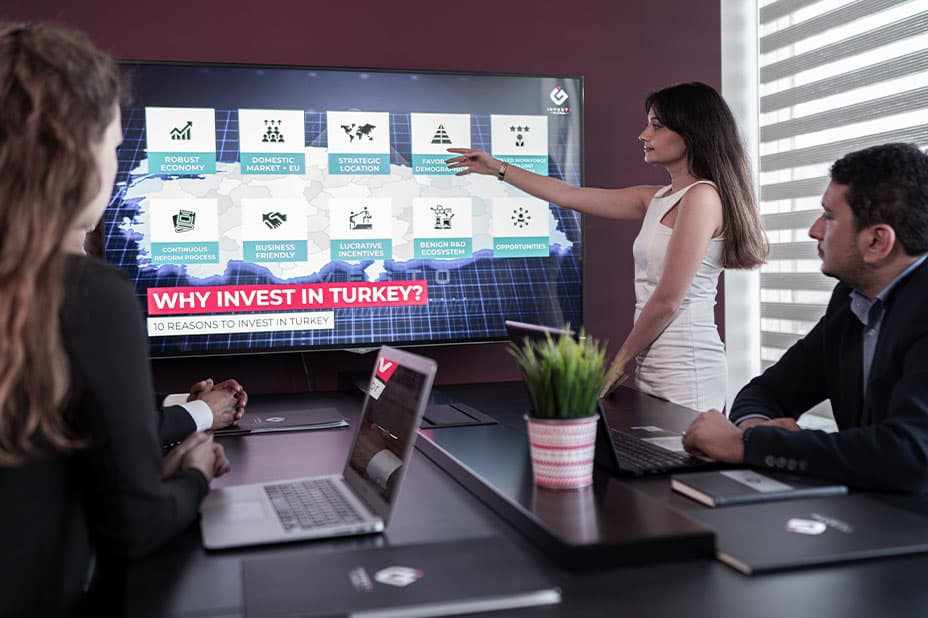

Remote or in person? Much of this can be done through a power of attorney. The full walk-through, stage by stage, is in our step-by-step guide.
Applications go through a security and background review before a decision is made. The final decision rests with the Turkish authorities
Travelling while you wait? Whether you can leave Turkey while an application is pending is assessed case by case — see the timeline and processing-time FAQs.
Steps shown are indicative — confirm the current rules and binding procedure with an advisor.
Timeline
How long does Turkish citizenship by investment take?
Nobody can promise you a date, and you should be wary of anyone who does. These are the ranges we usually see — your advisor confirms the current position for your file.
All in, six months to a year is realistic. These are ranges, not a guarantee.
Where the biggest delays come from
- Incomplete files — the most common source of delay
- Slow apostilles or sworn translations in your country
- A property that turns out not to qualify — see investment routes
- Large families with lots of documents
- Security and background checks, and residence-permit → application sequencing
- How quickly you return documents and attend biometrics
Processing times are indicative and vary case by case; they depend on the relevant authorities and are confirmed by your advisor. Investo Global guides your file end-to-end to keep it complete and avoid avoidable delays, but does not control or guarantee government processing times.
Can you travel while the file is pending? Yes, there’s no general ban. But tell your advisor your dates, because some steps need you there in person. See the FAQ on travelling during a pending application.
Documents
Documents: The Three-File Overview
It helps to think of the paperwork as three separate files. The exact records depend on your nationality, your family and the route you choose.
Personal file
Passports, birth and marriage certificates, documents proving the family relationship, a recent criminal record certificate and photos. Most of these need an apostille or consular legalisation, plus a sworn Turkish translation.
Investment file
The proof of your investment and the certificate of conformity from the relevant authority. For property, that’s the title deed, the valuation report, the bank records and the currency purchase certificate.
Procedural file
The residence permit records, the VAT-4 citizenship application form, the fee receipts and the record of your in-person appointments.
The detailed checklist has one owner. Personal documents, family evidence, apostille or legalization and certified Turkish translation are covered in the dedicated requirements guide.
Get the document checklist
A typical, advisor-confirmed set — sent by email or WhatsApp. No obligation.
The full checklist, including what each family member needs, is in our requirements guide, or have an advisor map the list to your case.
Costs & taxes
What does Turkish citizenship by investment cost?
The investment is the big number, but it isn’t the only one. For the property route, separate the one-off costs from the running costs.
One-off costs: the title deed fee; the valuation report, notary, sworn translations and apostilles; legal fees and, if you use one, an agency commission; compulsory earthquake insurance (DASK) when you buy, renewed every year; and government fees for residence permits, ID cards and passports, for each family member. Running costs: the annual property tax, building service charges (aidat) and utilities.
| Cost item | Type | Who pays & when | Amount |
|---|---|---|---|
| Qualifying investment (e.g. real estate) | One-time | Buyer, at purchase — single or combined units | On application |
| Title-deed transfer tax | One-time | Buyer and seller, at title transfer (the contract can leave it all to the buyer) | 2% each, of the declared value |
| Property appraisal (SPK valuation) | One-time | Buyer, before transfer | On application |
| Notary & sworn translation | One-time | Buyer, during process | On application |
| Apostille (home-country documents) | One-time | Buyer, before filing | On application |
| DASK earthquake insurance | One-time, then annual | Buyer, at/after purchase | On application |
| Agency commission | One-time | Buyer, at purchase | On application |
| Legal & advisory fees | One-time | Buyer, during process | On application |
| Residence-permit & ID card fees | One-time, per family member | Applicant, before citizenship filing | On application |
| Citizenship application & passport fees | One-time, per family member | Applicant, at filing/issuance | On application |
| Annual property tax | Recurring | Owner, yearly | 0.1% of the tax value for a home (0.2% in metropolitan areas) |
| Maintenance / aidat & utilities | Recurring | Owner, monthly/yearly | On application |
On the tax side, foreign buyers most often ask about property tax in Turkey. A title-deed transfer tax is due once, at transfer: by law 2% from the buyer and 2% from the seller, on the declared value, which cannot be lower than the property’s tax value (Fees Law No. 492, Turkish text). In practice the sale contract can leave the whole 4% to the buyer, so agree it in writing. A yearly property tax of 0.1% of the tax value applies to a home each year you own it — 0.2% in metropolitan municipalities (Property Tax Law No. 1319, Turkish text). Rental income is taxable in Türkiye, and if you sell within five years of buying, the gain can be taxed. Citizenship on its own doesn’t make you a Turkish tax resident; how much of the year you spend in Türkiye can affect your tax-residency status, so get advice if you plan to move
| Tax | When it applies | Rate | Note |
|---|---|---|---|
| Title-deed (property purchase) transfer tax | Once, at transfer | 2% buyer + 2% seller, on the declared value | By law each side pays its share; the contract can leave it all to the buyer |
| Annual property tax | Yearly, while you own | 0.1% for a home (0.2% in metropolitan areas) | Other buildings and land have different rates |
| Rental income tax | If you let the property | On application | Depends on income and personal situation |
| Capital-gains tax | If you sell within 5 years | On application | Rules and exemptions can change |
| Tax-residency trigger | Depends on your personal situation | On application | Confirm with an advisor |
One-time costs vs costs you keep paying.
Please note. Figures shown are indicative and provided on application. Actual government fees, taxes and professional costs depend on the property’s assessed value, your family composition and the rules in force at the time — and can change. Buying property or acquiring citizenship may affect your tax-residency status; confirm your personal position with a qualified advisor before you commit.
Can the investment be paid in instalments?
The qualifying amount has to be paid in full, and proven, before the application. If you buy something above the threshold, the part above USD 400,000 can sometimes be paid over time.
Treat any offer that promises citizenship while the qualifying amount itself is still being paid off as a reason to ask for the criterion and the responsible authority in writing before transferring anything.
Request a personalised cost breakdown
Share your property interest and family size, and an advisor returns an itemised, line-by-line estimate.
Benefits
What are the benefits of Turkish citizenship?
Turkish citizenship gives an investor and their immediate family a second nationality — adding international mobility, the right to live, work and own property in Türkiye, and access to public services as citizens, held indefinitely subject to Turkish Citizenship Law
The benefits investors ask about most are set out below. Figures and legal details here are indicative and should be confirmed with an advisor.
Travel
The Turkish passport gives visa-free or visa-on-arrival access to a long list of destinations, but it still needs a visa for the Schengen area, the UK, the US and Canada. The current list is on our Turkish passport guide.
Dual citizenship
You don’t have to give up your current passport, as far as Türkiye is concerned
Family
Your spouse and minor or dependent children can become citizens with you (Law No. 5901, art. 12(1)(b))
Living and working
You can live, work and run a business in Türkiye with no work permit or residence permit
Public services
Public schools and universities on citizen terms. State healthcare isn’t automatic: you’re covered once you’re registered with the social security system (SGK), through a job or by paying premiums yourself
Permanence
The citizenship doesn’t lapse when you sell the investment after the holding period; it is held subject to Turkish Citizenship Law
Two different things
Residence permit vs. citizenship — which applies to you?
People often mix these up. A residence permit lets you live in Türkiye. Citizenship makes you Turkish.
The practical question is what you actually need. If the goal is to spend extended time in Türkiye — living here, running something here, being with family here — a permit may be the proportionate answer. If the goal is a second nationality and the mobility of a second passport, a permit does not deliver it.
| Residence permit | Citizenship | |
|---|---|---|
| What you get | The right to live in Türkiye | A Turkish passport and full citizen rights |
| How long | Fixed term, renewable | Doesn’t expire; held subject to Turkish Citizenship Law |
| Investment | Can be supported by owning property, depending on location and current rules | A qualifying investment from USD 400,000 — see Investment Routes |
| Travel | You keep using your own passport | You can use a Turkish passport too — see Turkish passport |
| Best for | People who want to live here | People who want a second nationality |
Does a permit lead to citizenship? There’s also a separate, ordinary naturalisation route based on years of legal residence. It has its own conditions on language, income and residence, and we don’t advise on it. We handle the permit and the investment route, which sit in the same service line with the same legal team.
Because permit categories, terms and any property-value conditions are set by legislation that is amended, we do not publish those figures here. An adviser confirms which status fits your position, and what it currently requires.
Citizenship requirements in detail → · How our legal team handles both →
ⓘ Good to know — Investment vs. Other Paths to Citizenship
This page covers the investment route to Turkish citizenship — the service Investo Global advises on. Turkish citizenship may also be acquired through other legal paths, such as by descent or by marriage to a Turkish citizen. These rest on a family link or a qualifying marriage rather than an investment, carry their own evidence and waiting conditions, and sit outside the property and citizenship coordination we provide. For those routes, work with qualified immigration counsel. The main kinds of application are described in types of Turkish citizenship applications. If either might apply to you, say so in your first consultation.
There is also ordinary naturalisation, which rests on lawful residence in Türkiye over a continuous qualifying period together with conditions such as Turkish-language ability, sufficient income or occupation, and general public-health and public-order requirements. It has no investment threshold, which is why it is sometimes presented online as a cheaper way in — but it is a materially different process, with a far longer horizon and its own evidence, and it is not a discounted version of the investment route. We do not advise on it.
Why Investo Global
Why Investo Global
We’re an investment consultancy, not a law firm. We run the whole file and work alongside licensed Turkish citizenship lawyers for the legal steps. Our approach is process, not promises: we tell you what we can coordinate, and what rests with the Turkish authorities.
What “guided end-to-end” covers
We shortlist the property, order the valuation, coordinate the title transfer and the certificate of conformity, and prepare the residence and citizenship files. What we can’t do is guarantee the outcome or the timing. That’s the state’s decision.
Want the fuller picture? See our advisory services or read more about Investo Global.
Why clients work with us
Focused expertise
Turkish citizenship by investment is a core service, handled by a dedicated team alongside independent licensed lawyers
Multilingual and remote-ready
We advise in English, Russian, Arabic, Persian, Turkish, Spanish, French, Azerbaijani, Urdu and Pashto, with parts of the process handled by power of attorney where permitted
On the ground in Istanbul
Meet us in person at Nish Istanbul (Yenibosna / Bahçelievler), or reach your advisor by WhatsApp.
Transparent by default
Figures on this page are indicative; we confirm binding details with you before you commit.
Experienced team
11 years in the market, 1,000+ clients, a citizenship team that works in 10 languages
Is this programme genuine? How to check for yourself
It is, and you don’t have to take our word for it. The route is set out in Turkish law, and the thresholds are published by the Investment Office of the Presidency. Read the official sources directly — NVI: acquisition of Turkish citizenship and Invest in Türkiye: acquiring property and citizenship.
Be careful if anyone guarantees approval, quotes a price well below the published minimum, or pushes you to send money before the valuation and title checks are done. We don’t claim a perfect approval record, and no honest adviser can — the decision rests with the Turkish authorities.
Sources
- Invest in Türkiye — Acquiring Property and Citizenship Covers the investment thresholds and routes, the holding commitment for property and the limits on foreign ownership.
- Turkish Citizenship Law No. 5901 (official text, in Turkish) Sets the exceptional route to citizenship and who it extends to: the spouse and minor or dependent children (art. 12(1)(b)).
- Regulation on the Implementation of the Turkish Citizenship Law (official text, in Turkish) Sets the qualifying investment routes, their minimum amounts and the three-year holding condition (art. 20(2)).
Rules can change. Thresholds, routes and procedures can be amended by official decision. The rules in force are confirmed for your case before you commit.
FAQ
Frequently Asked Questions
Short, direct answers to the questions investors ask most. Figures are indicative and confirmed with an advisor.
Note. Answers are general guidance; figures are indicative and confirmed with an advisor.
Book a consultation
Book a Consultation
Tell us what you’re trying to achieve, and we’ll tell you honestly which route fits, what it’ll cost and how long it’s likely to take. There’s no obligation.
No obligation · Served in 10 languages · Your details stay private.
Ways to reach us
See our full contact details or visit us at Nish İstanbul, Istanbul → /contact-us
Request your consultation
Figures shown on this page are indicative and are confirmed with your advisor before any commitment. We provide guided, end-to-end support — not a guaranteed outcome or timeline.